

Why This Works
The honest reason most companies hire full-time
A full-time senior sales leader makes sense in one situation: when the sales team is large enough, and the commercial function complex enough, that the role genuinely requires five days a week of effort. Typically that means eight or more salespeople, multiple territories, and a revenue function that spans sales, marketing, and partnerships.
Before you reach that scale, a full-time CRO or VP of Sales is often the wrong tool for the job, and a very expensive way to find that out.
The numbers that should make you pause…
Before you make another full-time hire, look at what it actually costs.
The business case for fractional sales leadership, and why more founders are choosing it over the full-time hire
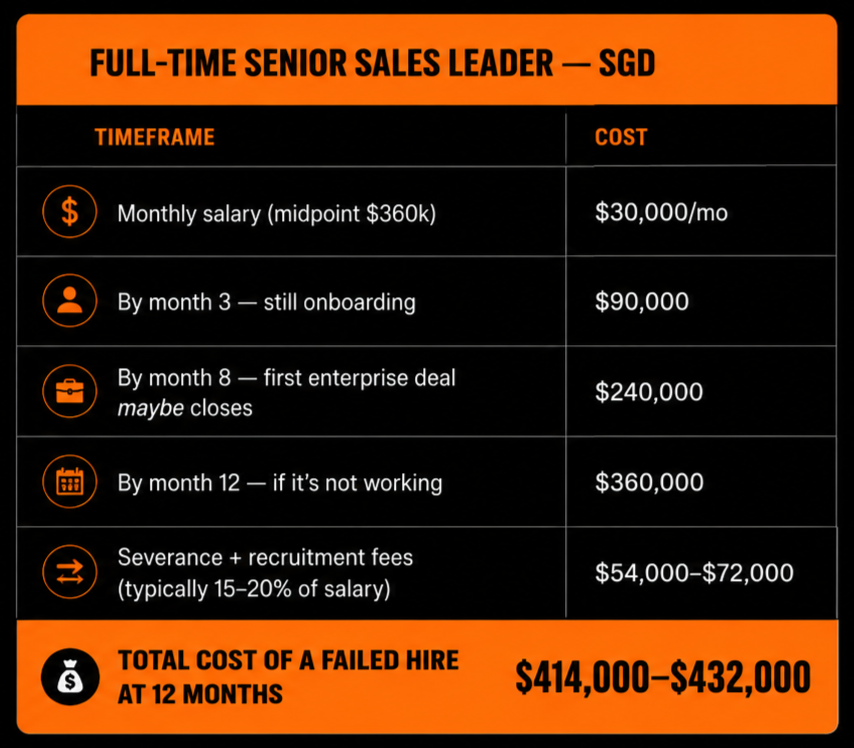
That's the number that's easy to see. It's not the number that does the most damage.
What you can't see is the hidden cost of a toxic hire
A bad sales leader doesn't just fail to deliver. In many cases, they actively damage what you already have. These costs don't appear on any invoice, but they're real, they compound, and some of them are permanent.
Your best salespeople leave
A strong individual contributor doesn't need to tolerate a poor manager. They have options. When a new sales leader comes in with a big ego, dismisses what the existing team has built, and makes it clear that everything done before them was wrong, your best people start taking calls from recruiters. The ones who leave first are always the ones you most wanted to keep.
Your clients and prospects get cold feet, and they don't always tell you why
Enterprise relationships in fintech are personal. Buyers trust the people they've dealt with, not just the company. When a new sales leader comes in guns blazing, repositioning the product, changing the commercial conversation, making promises the previous team didn't make, and then disappears twelve months later, your clients notice.
But it's not just the clients mid-deal who are affected. Your prospects notice too. Word travels in financial services. Singapore is a small market. Hong Kong is smaller. When you've cycled through two senior sales hires in three years, sophisticated buyers start asking questions you don't want to answer. Is the product working? Is the business stable? Do we want to build a dependency on a vendor that can't hold onto its own commercial leadership?
Deals that were progressing quietly go back to square one. Renewals that seemed certain become conversations. And new prospects who were warming up go cold, not because of anything you said, but because of what they heard, or noticed, or quietly concluded.
You often won't know this is happening. Nobody calls to tell you they've lost confidence. They just stop returning calls.
Institutional knowledge disappears
Old-school sales leaders operate from their heads, not from your CRM. No notes logged. No account maps. No documented qualification history. When they leave, the pipeline leaves with them, because the pipeline only ever existed in their relationships and their memory. You inherit a Salesforce full of stale contacts and a blank page where your opportunity history should be.
Competitive intelligence walks out the door
A sales leader who is unhappy, politically motivated, or already looking for the exit has access to everything. Your pricing strategy. Your product roadmap. Your largest client relationships. Your weakest commercial terms. When they leave, particularly if they leave badly, that information travels with them. And in a small market like Singapore fintech, it almost always ends up somewhere it shouldn't.
They go straight to a competitor
Notice periods are negotiable. Non-competes are difficult to enforce. A senior sales leader who has spent twelve months inside your business, learning your strategy, your clients, and your commercial model, is an extremely valuable hire for the company trying to beat you. It happens more often than founders talk about.
The total cost no one calculates
Add the salary cost, the recruitment fees, the departing salespeople, the wobbling client relationships, the empty CRM, and the competitive exposure, and a failed senior sales hire in a small, relationship-driven market like APAC fintech can set a company back two to three years.
Not twelve months. Two to three years.
That's the real cost of the wrong hire. And it's why the question isn't just whether you can afford a fractional sales leader.
It's whether you can afford not to have one.

Senior sales leaders are, by definition, exceptional at selling. They are confident, articulate, and very good at understanding what a buyer wants to hear. They have spent their careers reading rooms, building rapport, and closing.
You are the buyer. And the interview process is their sales cycle.
The ego problem nobody talks about
Senior sales leadership attracts a particular personality type. Driven, competitive, high-confidence, strong opinions. In the right environment those traits are genuinely valuable. In the wrong one they're destructive.
The big bold ego that walks into your business ready to rebuild everything from scratch is also the ego that will alienate your best existing salespeople, dismiss the institutional knowledge your team has built, and prioritise being seen to lead over actually making the team better. If you have good salespeople already in place, be very careful about what you bring in above them. A poor cultural fit at the leadership level doesn't just slow things down. It walks your best people out the door.
The interview problem
Great sales leaders are impossible to evaluate in an interview. Not because the process is badly designed — but because the person you're interviewing has done this before, and they're better at it than you are.
They know exactly what a founder wants to hear. They'll talk about pipeline discipline and coaching culture and building for scale. They'll have a compelling story about a team they transformed or a number they hit. What you can't see in the room is how they behave when a deal is slipping, how they treat an underperforming rep, or whether their confidence comes from genuine capability or a very well-practised performance.
The only real antidote is reference checks that go beyond the names they give you. Talk to people who reported to them, not just people who hired them. Ask specifically how they handled failure, conflict, and underperformance. The picture you get will often be very different from the one you formed in the room.
The network hire trap
One of the most seductive pitches a senior sales leader makes is the network pitch. "I've spent fifteen years building relationships with the CFOs at the top financial institutions in the region. I walk in the door, I pick up the phone, and we have meetings."
Here's what actually happens.
The network is real. But relationships built over fifteen years in a previous context don't automatically transfer to a new product and a new company. The calls get made, some meetings get booked, but conversion requires all the things the network hire wasn't asked to build like qualification frameworks, discovery processes, negotiation strategy, AI adoption in sales, sales systems. And while they're burning through their relationship capital trying to close deals personally, nobody is building the sales function.
A great individual contributor who can leverage a strong network is genuinely valuable. Pay them well and let them do what they're good at. But that is not a sales leader. A sales leader's job is to build a function that doesn't depend on any single person's relationships — including their own.
AI isn’t optional anymore

the ai advantage
1. Your people are using AI, not avoiding it
The biggest competitive gap in sales right now isn't talent. It's adoption. Most sales teams are still doing manually what AI can now do in seconds: research, deal dynamics, personalisation, follow up, content creation, account mapping.
I've implemented AI across every part of a commercial function from outbound lead generation to building winning proposals.
Personal productivity tools that give reps back hours every week. Marketing collateral generated on demand instead of waiting weeks for design. Agents that draft and post LinkedIn content for every salesperson on the team, automatically, consistently, without anyone having to remember to do it.
Imagine every person in your sales org showing up on LinkedIn every week. Free distribution. Free pipeline. Zero extra headcount. That's not a future state. That's something I've built and run, for my own business and for the businesses I work with.
If your team isn't using AI as standard practice, you're not behind a competitor with more budget. You're behind a competitor with the same budget who simply started earlier.
2. Your strategy is built on data, not opinion
Go to market decisions used to take weeks of workshops and gut feel. Now they take hours, if you know what to ask for.
I use AI to map ideal customer segments, run competitive analysis, stress test positioning and feature capabilities, and build the business cases founders need for their boards and investors. Not as a replacement for commercial judgement. As an accelerant for it. The thinking is still mine. The output is faster, sharper, and easier to act on.
This applies across the business, not just sales. Marketing frameworks can ensure consistent story telling and voice of your brand with every piece of content and every post. Product roadmaps can be informed like never before on your NPS and user group responses or by what competitors are shipping and what customers are actually asking for. Pricing models get stress tested against market data in minutes. Partnership dynamics get be flagged as the real deal or a red flag time drain in a just few minutes. Messaging tested against real objections before it ever reaches a prospect.
The companies winning right now aren't the ones with the biggest strategy teams. They're the ones who can turn insight into action in days instead of quarters.
3. Your systems talk to each other
Most sales teams lose hours every week to admin. Updating the CRM. Formatting documents. Pulling data from one tool to use in another. None of that is selling. All of it is necessary. And almost all of it can now be automated.
I've connected tools like Claude, Chat GPT, Canva, and Notion directly into commercial workflows, so proposals, decks, reports, and pipeline updates happen with a fraction of the manual effort. Unstructured data, agents, language models, I've worked with all of it, and I know what's genuinely useful versus what's just a demo.
A sales org that flies isn't working harder. It's removed the friction between having an idea and acting on it. That's what AI, implemented properly, actually does.
If your sales function isn't using it, you're already behind.


what you need
The hire most founders think they want is a CRO who closes deals from their network, manages the team, builds the strategy, reports to the board, designs the GTM, coaches the reps, and does it all for SGD 360,000 a year.
That person doesn't exist. And if they did, they wouldn't take the job.
If your pipeline is the problem, you need a builder, someone who can diagnose what's broken and construct the commercial infrastructure to fix it. If your team performance is the problem, you need emotional intelligence and operational discipline, not a big personality. If your GTM is the problem, and it usually is, even when it looks like a people problem, no hire will fix it. You need to solve the strategy before you scale the headcount.
The best sales leader you can hire is not the most impressive person in the interview room. It's the person who asks the most uncomfortable questions about your business before they agree to take the role.
The thing that matters most
A repeatable, scalable, winning sales function is built on process and frameworks and smart technology, not on the personal capability of whoever happens to be running it today. If your sales function can't survive the departure of your current sales leader, you don't have a sales function. You have a dependency.
The goal of any senior sales engagement, fractional or full-time should be to make itself less necessary over time. To leave behind a team that knows how to qualify, a process that produces consistent results, and a GTM that doesn't need to be reinvented every time someone new comes in.
That's what a sales function looks like when it actually scales. And that's what you should be hiring for.